Page 2 of 2
Re: Accidental spelling question
Posted: 06 Sep 2026, 03:57
by frames
Seconds are fine as-is: one solution could be starting the bar with a Gb instead of an F#, but I’m not entirely sure it’s necessary.
In the firsts I’d probably go with B C# Eb: I don’t particularly like writing or reading diminished seconds, and to me the diminished third that’s necessary to switch from sharps to flats in a whole tone scale is easiest to parse when the diminished third is placed between two notes that have to have accidentals.
Re: Accidental spelling question
Posted: 06 Sep 2026, 22:47
by OCTO
MichelRE wrote: 06 Sep 2026, 02:13
OCTO wrote: 05 Sep 2026, 21:19
If the
phrase starts from E

, maybe you can respell F

-G
etc.
Otherwise it is ok.
I'll look at it again.
I have a tendency to avoid writing C and F
and B and E

I remember playing operas by Wagner and Strauss, they are full of such accidentals.
Re: Accidental spelling question
Posted: 07 Sep 2026, 00:00
by MichelRE
LOL Wagner and Strauss are also replete with double (s)harps and double flats!!!
Re: Accidental spelling question
Posted: 07 Sep 2026, 13:32
by RMK
Sometimes sextuple harps...
Re: Accidental spelling question
Posted: 07 Sep 2026, 15:07
by MichelRE
LOL, that was a typo (for some reason, if I don't strike the "S" key on my keyboard in just a very specific direction, it doesn't respond.)
Re: Accidental spelling question
Posted: 09 Sep 2026, 17:40
by Fred G. Unn
MichelRE wrote: 04 Sep 2026, 14:39
I can't say "well this passage is in X-minor, therefore I need to use X-spelling."
I'm trying to make READING the passage as easy on the eyes as possible for the performers.
Vln. II is just C# ascending melodic minor starting on E (up to the Eb) so one option could be to use that spelling in that bar. It uses a B# but would be easily read as it's a standard scale that they practice every day. Alternatively, just switch the Gb to F# and leave the whole bar as flats.
For Vln. I, I think with whole tone scales I'm more used to seeing sharps when this is ascending, and then using D# - F natural, and using flats with Db - B natural when descending. Here are a couple of examples from a Guy Lacour etude:
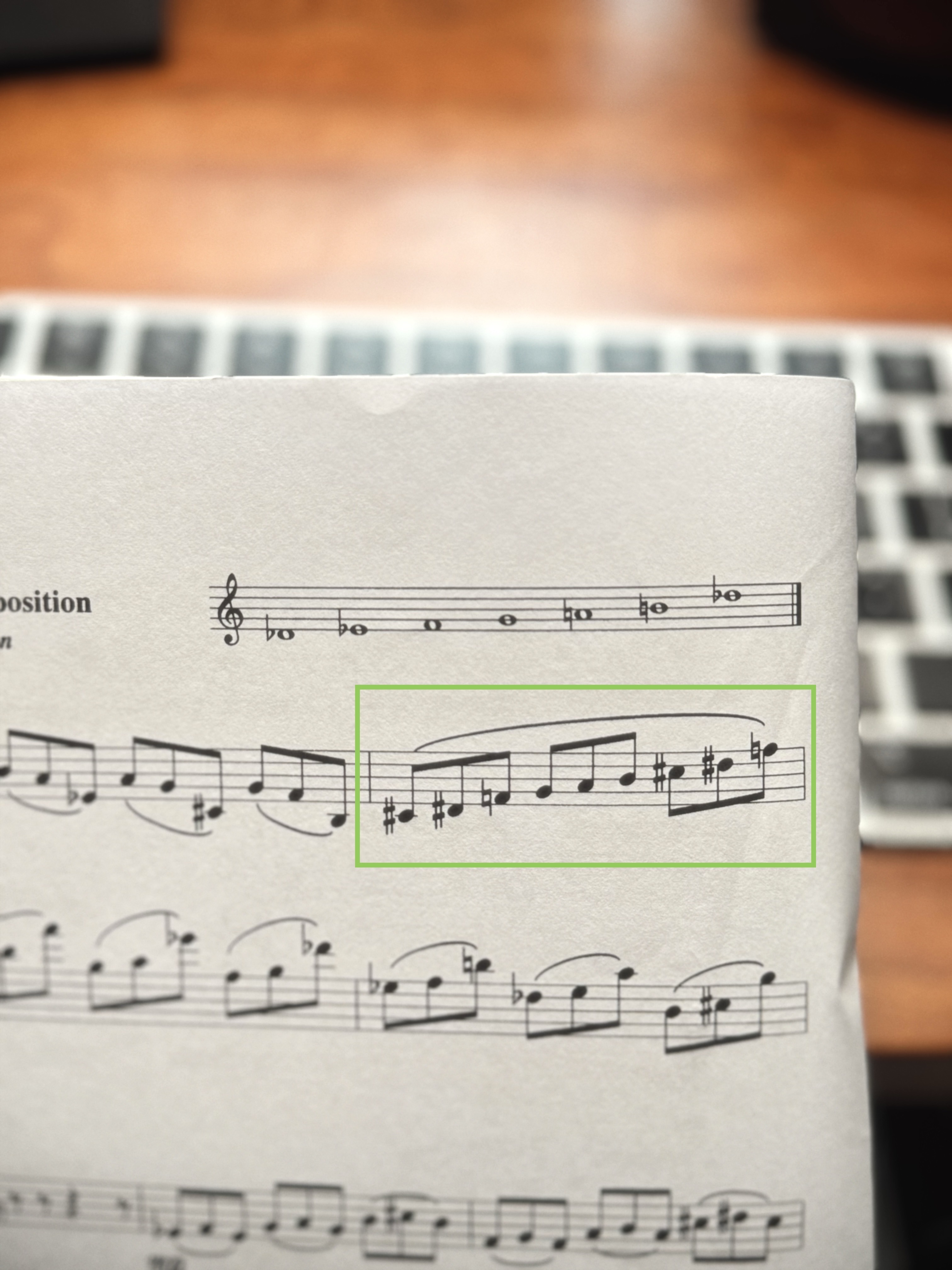
- IMG_5280.jpeg (1.13 MiB) Viewed 102 times

- IMG_5281.jpeg (1010.28 KiB) Viewed 102 times
I think what you have is easily enough read though, just presenting some rationale behind other options.