Page 3 of 6
Re: Quintuplet, a correct one?
Posted: 20 Jun 2026, 17:58
by OCTO
sugarfree wrote: 20 Jun 2026, 17:41
Screenshot 2026-06-20 at 10.40.40 AM.png
What about two notes on one beat?
###
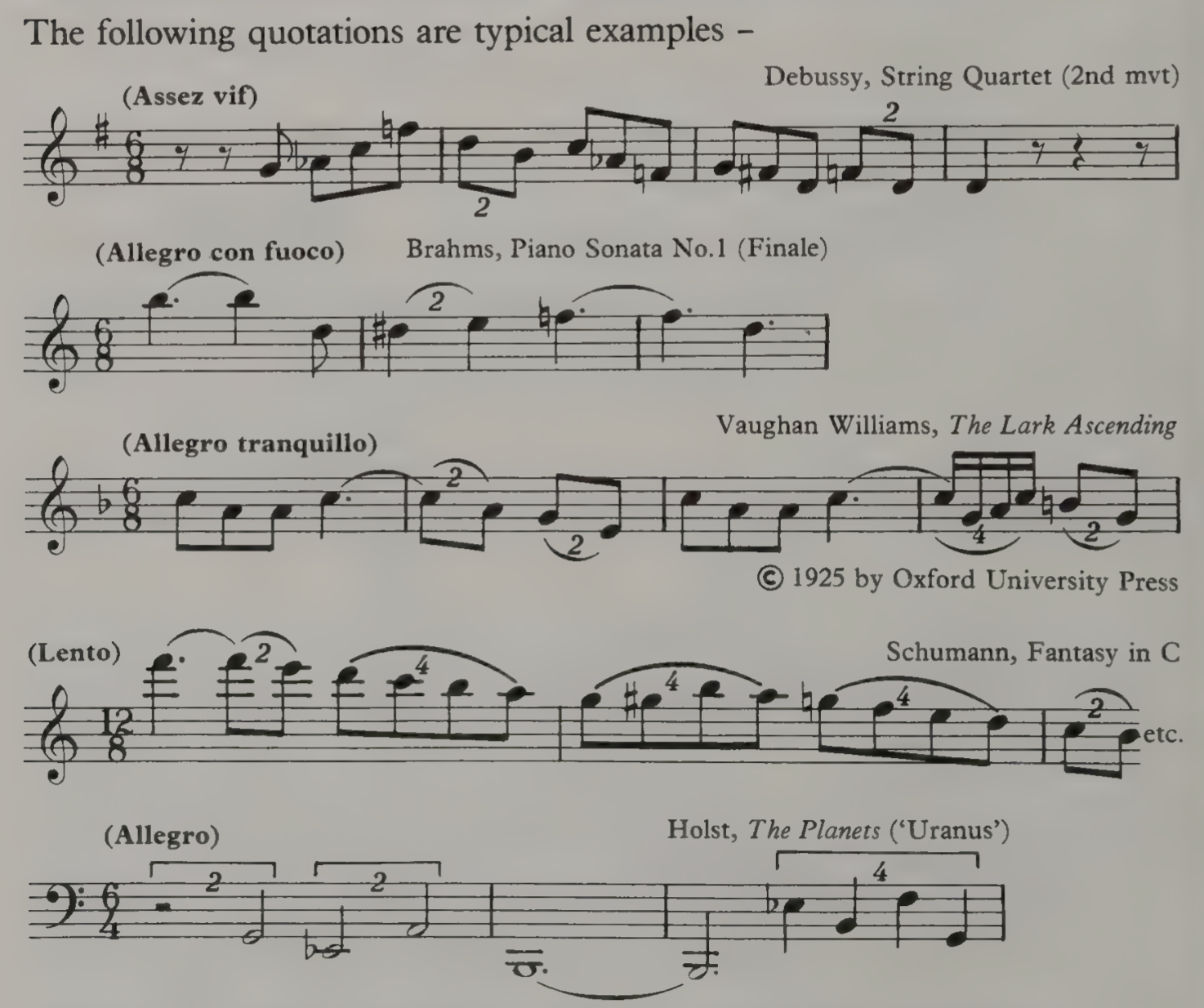
Let us consult ABRSM (Associated Board of the Royal Schools of Music), "Music Theory In Practice AB" by Eric Taylor. Here we go!

- ScreenShot 2026-06-20 at 19.57.09.png (784.22 KiB) Viewed 3624 times

- ScreenShot 2026-06-20 at 19.57.22.png (483.3 KiB) Viewed 3624 times
Thus:
- ScreenShot 2026-06-20 at 20.00.00.png (1.12 MiB) Viewed 3608 times
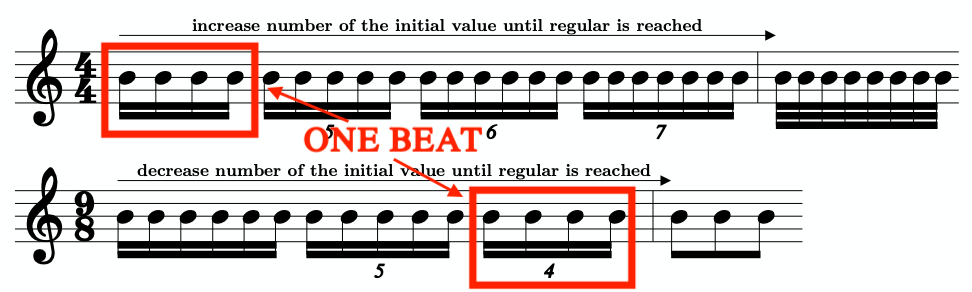
For me the logic says that in the case of X/8 time signature, each beat corresponds to the regular 4

in simple time, meaning the tuplet of 4:3 is actually 4:6, thus four
—notes, not 4

—notes
- ScreenShot 2026-06-20 at 20.19.55.png (48.81 KiB) Viewed 3617 times
In both cases, one single beat has 8-notes as subvalue, and four
—notes as sub-subvalue.
Re: Quintuplet, a correct one?
Posted: 20 Jun 2026, 20:39
by sugarfree
Logic can support both systems. System A may work better for mixed-meter music where the beat tempo is constant-- (

=

). For metric modulations where
=
, system B is more consistent.
Re: Quintuplet, a correct one?
Posted: 20 Jun 2026, 22:50
by LSL2026
OCTO wrote: 20 Jun 2026, 16:48
As I stated above, I believe that
A)
in simple time, tuplets increase the regular value until the next regular value is reached.
B)
In compound time, tuplets reduce the regular value until the next regular value is reached.
As you pointed out, it is not always a matter of "surplus," but sometimes also of "deficit."
ScreenShot 2026-06-20 at 20.19.55.png
Yes, this is the traditional way of doing it.
I said it differently - rather than “reducing to the regular value”, you can think of it as changing immediately after the regular value.
In simple meters, the value is used up to the next regular division, which changes to half duration values.
In compound meters, the value is used up to and INCLUDING the next regular division, which then immediately after changes to half duration values.
Just reading your 9/8 right to left

But I think many wanted to apply the “scaling logic” of simple meters to compound meters and in that case the duplet “would need to be” or should be quarter note duplets, not 8th note duplets.
I would argue, if I drunk and just playing devil’s advocate, that some publishers simply “used it wrong” and the standard was the “a beat in simple is a beat in compound” thinking - 4 16ths in a beat of 6/8.
And I fail to see the harm in the system for simple music and basic borrowings.
Once it gets beyond that, rather than as the ABSRM thing says - “using both in one piece”, I would be using ratios to make things crystal clear.
Because while for simple rhythms we can deduce what its based on the measure, if more rests or other nested tuplets etc. are involved that becomes less easy to do.
Re: Quintuplet, a correct one?
Posted: 21 Jun 2026, 06:43
by Magnus Johansson
Why does Eric Taylor seem to think that logic is "clearly on the side of System A" (the deficit system)?
Re: Quintuplet, a correct one?
Posted: 21 Jun 2026, 09:27
by OCTO
Magnus Johansson wrote: 21 Jun 2026, 06:43
Why does Eric Taylor seem to think that logic is "clearly on the side of System A" (the deficit system)?
Eric died aged 88 on December 25 2016, at a Care Home in Wallingford, Oxfordshire, so there is no chance to know…
P.S. You use Debian? My favorite OS!
Re: Quintuplet, a correct one?
Posted: 21 Jun 2026, 09:54
by Magnus Johansson
OCTO wrote: 21 Jun 2026, 09:27
Magnus Johansson wrote: 21 Jun 2026, 06:43
Why does Eric Taylor seem to think that logic is "clearly on the side of System A" (the deficit system)?
Eric died aged 88 on December 25 2016, at a Care Home in Wallingford, Oxfordshire, so there is no chance to know…
P.S. You use Debian? My favorite OS!
OK, and didn't he ever explain why he perhaps thought the deficit system has the logic on its side?
Yes, some 20 years ago I started exploring Linux operating systems and finally found Debian or Debian-based systems the best; Q4OS is of the latter category.
Re: Quintuplet, a correct one?
Posted: 21 Jun 2026, 11:15
by Magnus Johansson
Let's take a look at Eric Taylor's music examples:
Debussy: deficit duplets.
Brahms: surplus duplet.
Vaughan Williams: deficit duplets and deficit quadruplet.
Schumann: deficit duplets, and deficit quadruplets really consisting of beamed together deficit duplets.
Holst: surplus duplets and surplus quadruplet
I prefer Brahms and Holst in this respect, but have no problem with Debussy. The Vaughan Williams bar with a deficit quadruplet and a deficit duplet looks very strange to me. The notation in the Schumman piece I find confusing because of the beamed together duplets marked as quadruplets.
Re: Quintuplet, a correct one?
Posted: 21 Jun 2026, 12:49
by OCTO
Magnus Johansson wrote: 21 Jun 2026, 09:54Yes, some 20 years ago I started exploring Linux operating systems and finally found Debian or Debian-based systems the best; Q4OS is of the latter category.
Sometimes I use Fedora because of hardware compatibility issues with Debian. Otherwise, I would switch to Debian, but I am heavily dependendent on Sibelius, Ableton Live, and Logic, not only for my own work, but also for collaborating with other people.
For me, Debian is the only truly right and ethical operating system.
Re: Quintuplet, a correct one?
Posted: 21 Jun 2026, 12:58
by OCTO
Magnus Johansson wrote: 21 Jun 2026, 09:54
OK, and didn't he ever explain why he perhaps thought the deficit system has the logic on its side?
Let's assume you move from a compound time signature to a simple one. The last one is 4-plet and the first one in the next time is 4 notes on one beat. In your system it would look like this:

- ScreenShot 2026-06-21 at 14.56.55.png (10.11 KiB) Viewed 3549 times
In the "A" system, it would look like this:

- ScreenShot 2026-06-21 at 14.57.07.png (10.54 KiB) Viewed 3549 times
Which one does look to you more convenient and easier to understand?
Re: Quintuplet, a correct one?
Posted: 21 Jun 2026, 13:20
by Magnus Johansson
OCTO wrote: 21 Jun 2026, 12:58
Magnus Johansson wrote: 21 Jun 2026, 09:54
OK, and didn't he ever explain why he perhaps thought the deficit system has the logic on its side?
Let's assume you move from a compound time signature to a simple one. The last one is 4-plet and the first one in the next time is 4 notes on one beat. In your system it would look like this:
ScreenShot 2026-06-21 at 14.56.55.png
In the "A" system, it would look like this:
ScreenShot 2026-06-21 at 14.57.07.png
Which one does look to you more convenient and easier to understand?
The surplus version.