Page 1 of 3
Flipping the center line note?
Posted: 26 Jun 2026, 05:18
by LSL2026
What are you thoughts on the following (see attachment)?
I find it “silly” to have the one note in the measure to be stemmed the opposite direction when it’s a center line note - especially given what it does to the slur in this case. Of course, there are other issues that are more extreme.
I’ve always head “center line note has stems down by default but may flip” - and usually that’s for a reason that makes things tidier when it’s flipped.
If it’s six one way, half dozen the other, I’d leave it down. It irks me in Bass clef if it’s C C D C and the D flips down, but I can even live with that. But in a case like this, there’s a clear benefit to me by flipping it.
What’s the consensus here?
Re: Flipping the center line note?
Posted: 26 Jun 2026, 06:17
by Magnus Johansson
Hello! I believe I would have written it this way:
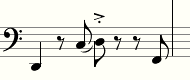
- Screenshot_20260626_081304.png (2.3 KiB) Viewed 1575 times
Re: Flipping the center line note?
Posted: 26 Jun 2026, 09:06
by OCTO
LSL2026 wrote: 26 Jun 2026, 05:18
What are you thoughts on the following (see attachment)?
What’s the consensus here?
The second is perfectly ok. Read in "Behind bars" about flipping stems in such situations.
Re: Flipping the center line note?
Posted: 26 Jun 2026, 11:10
by David Ward
In manuscript, I would have kept the stem up. As OCTO says, it is perfectly OK.
I've sometimes (often?) allowed the software to ‘do its thing’ (stem down in this example) when I might have been better to have overridden it. (That could perhaps be the subject for another thread.)
Re: Flipping the center line note?
Posted: 26 Jun 2026, 12:29
by John Ruggero
Dorico has engraving options for this situation. I have mine set for Determine by Context because adhering strictly to "middle line stem down rule" leads to awkward-looking results:
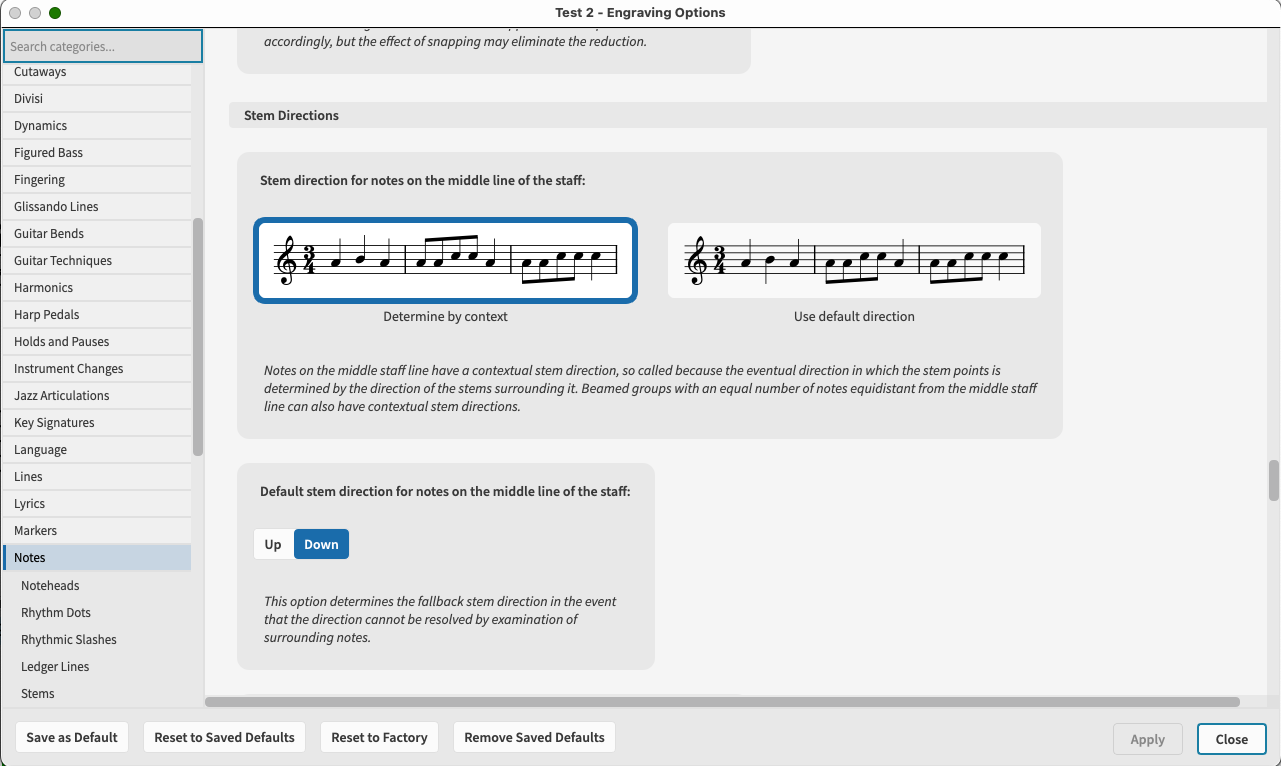
- Dorico Engraving Options.png (133.25 KiB) Viewed 1526 times
Here is what Dorico does for larger intervals than a second using this option This looks best to me as well:
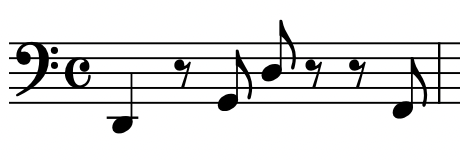
- Example.png (28.22 KiB) Viewed 1526 times
Interestingly, in the 18th century and perhaps even later many composers and engravers adhered to a "middle line stem up rule". However, they also allowed the stem direction of non-middle line notes to vary depending entirely on context. Recent urtext editions are now beginning to adhere more to the latter approach regarding older music.
I follow the following rule for all aspects of notation: do what looks most musical and communicates best.
Re: Flipping the center line note?
Posted: 26 Jun 2026, 22:10
by LSL2026
Thanks All! Glad to know I’m not just being a maverick

The piece actually also has a number of C-D beamed together, which of course take the stems up because of the C. So there’s extra incentive to flip them in this context.
It’s pretty cool that Dorico has that option.
FWIW, I also feel like there’s usually other things below the staff - dynamics, expressions, etc. that making the middle stem go up would make more sense - vocal music too because of text below.
Re: Flipping the center line note?
Posted: 26 Jun 2026, 23:31
by frames
I’m definitely more of a “default to stem down” person: I rarely will upstem a center line note except in very specific circumstances. For me, having the center line note be variable makes sightreading ever so slightly more difficult because all of the other notes have a defined default stem direction that—outside of two-part writing on one staff—is rarely deviated from: there are slightly different conventions that govern stem directions for beamed groups and chords that lead to notes having their stems flipped, but those rules are generally very predictable.
Another reason why I’m generally opposed to variable center line stem direction is that as a convention in professionally copied or engraved music during the 20th century it was explicitly moved away from (Read, Ross, Roemer, and Stone all call it out as a historical practice that is to be avoided) until Behind Bars came out: while I do appreciate how comprehensive Gould is in a lot of areas (and it’s still the first book I pick up when I have an engraving or notation question), there are many sections of the book that are out of step with publishing trends from the last several decades or run completely contrary to mainstream practices (I’m thinking of how she handles instrument changes in particular), and in my opinion this is one of them.
I am okay with flipping center line stems, particularly in full scores, if a downstem makes slurs unruly, but I do treat it as a “break glass in case of emergency” tool and avoid it if possible.
Re: Flipping the center line note?
Posted: 27 Jun 2026, 00:57
by Shinianqi
I completely agree with frames' remarks.
Re: Flipping the center line note?
Posted: 27 Jun 2026, 02:08
by MichelRE
I'm a variable direction person myself. I see absolutely no reason to have such a rigid and arbitrary rule.
reading the music isn't easier if one single note has its stem in the opposite direction from all the other notes around it. quite the opposite.
Re: Flipping the center line note?
Posted: 27 Jun 2026, 03:46
by Shinianqi
MichelRE wrote: 27 Jun 2026, 02:08
I'm a variable direction person myself. I see absolutely no reason to have such a rigid and arbitrary rule.
reading the music isn't easier if one single note has its stem in the opposite direction from all the other notes around it. quite the opposite.
I think that in terms of reading, playing, and especially sight-reading (as frames mentioned), performers usually rely not only on the position of the notehead to identify the specific pitch, but also on the overall "shape" of the note. Having a standard default stem direction within the staff—rather than handling each case subjectively—is not without reason and meaning. In the vast majority of cases, keeping stems down by default instead of flipping them arbitrarily can effectively avoid unnecessary cognitive load for performers when identifying the same pitch within the same score.
Of course, rules are always just tools to assist us, and when necessary, any rule can be broken—frames alluded to this as well. But I think people may have different opinions on what constitutes a "necessary" situation.
Regarding the case LSL posted at the top, it actually leads to another topic: when stems are in opposite directions and thus are back-to-back, the spacing between the two notes appears narrower than when they are in the same direction. In such situations, it is common practice to increase the space slightly to ensure visual balance—a technique often used even in the era of hand-engraving.