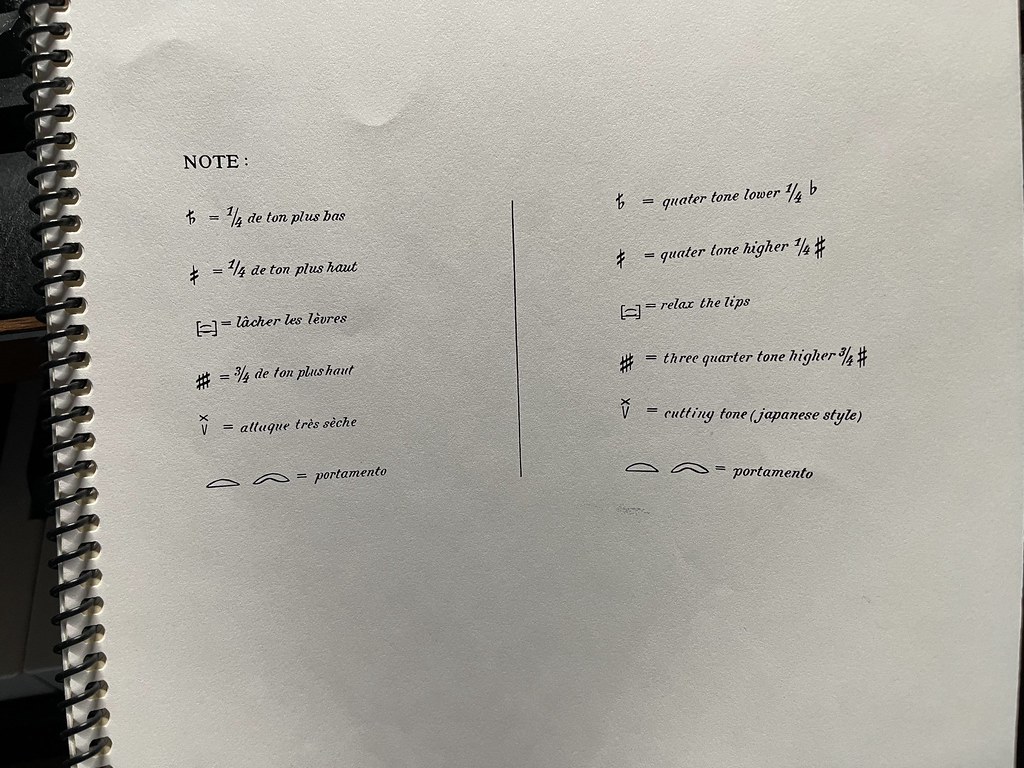
They are often different for wind players though. It's tricky because sometimes they will be played the same, and sometimes not. For example, all the half step straight line glisses in Ryo Noda's Maï could never be notated with a wavy gliss. The player will make these as smooth as possible using a combination of voicing, lip pressure, and slowly opening/closing keys. (1/2 step can basically be done with lip pressure alone too.) A wavy gliss wouldn't make any sense here, and the player would probably end up adding pitches that aren't intended:MichelRE wrote: 11 Mar 2023, 14:24 For example, someone argued that a straight line gliss was different from a wavy line gliss in actual performance. This is pure horse-pucky. They are simply different notation conventions from different periods in time for the exact same performance technique.

For longer glisses they will much more likely be played more or less the same, but with subtle differences. For wavy I would just play chromatically and not worry about smearing from note to note, and straight I would use voicing and lip pressure to make the note transitions as smooth as possible. I'm sure I must have some "advanced technique" saxophone or flute book somewhere that goes into this so I'll look around.